CXJPowers · Reliable Energy Storage Battery Supply Manufacturer in China


2026-05-11 Author : CXJPowers
Portable power stations have evolved into essential commercial energy storage solutions for modern industries. From construction sites to emergency response teams, businesses now rely on portable energy systems to maintain continuous operations without dependency on the grid.
This guide explains how to choose the right portable power station for business use, comparing handheld models (800W–1800W) and industrial wheeled systems (2400W–3200W).
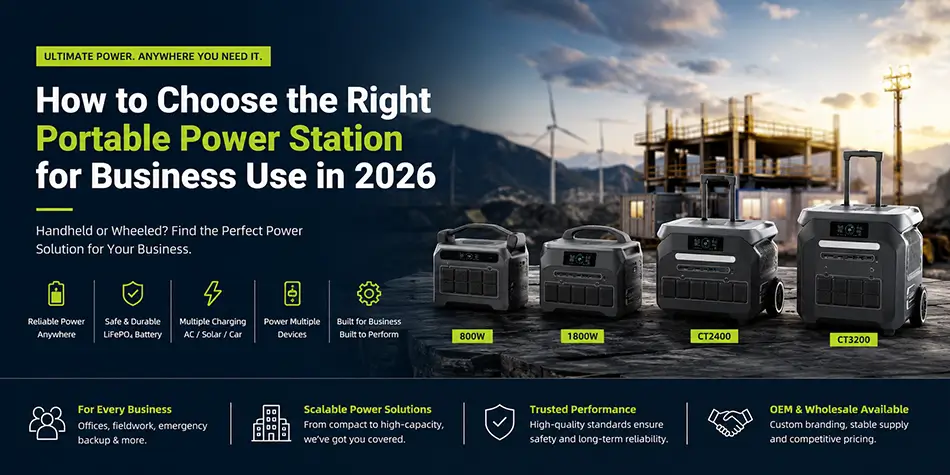
A business-grade portable power station is a rechargeable energy storage system designed to supply stable electricity for professional and industrial applications.
Unlike consumer models, commercial units focus on:
These systems are widely used as mobile power supply solutions in industries requiring flexibility and reliability.
Businesses are rapidly replacing fuel generators with portable power stations due to efficiency and sustainability advantages.
This makes them ideal for commercial backup power systems, especially in regulated or noise-sensitive environments.
Choosing the right system depends on power demand, mobility requirements, and operational environment.
P=800W∼1800WP = 800\text{W} \sim 1800\text{W}P=800W∼1800W
Handheld models are compact mobile energy solutions designed for light commercial use.
P≥2400WP \ge 2400\text{W}P≥2400W
Wheeled systems are industrial-grade portable power stations designed for high-demand applications.
These systems act as portable energy storage systems for commercial use.
Selecting the right model requires evaluating technical and operational factors.
Power output determines what devices you can run:
Modern business-grade systems use LiFePO4 batteries, offering:
Professional portable power stations support:
This ensures off-grid energy flexibility.
For distributors and B2B buyers, consider:
Portable power stations are widely used across multiple industries:
Stable power for tools, lighting systems, and temporary offices.
Reliable energy for sound systems, cameras, and lighting rigs.
Backup power for communication and medical equipment.
Remote maintenance and field service operations.
Portable energy systems for short-term project deployment.
The demand for commercial energy storage systems is growing due to:
Portable power stations are becoming a core part of modern industrial power infrastructure.
It depends on load requirements. 800W–1800W is suitable for small operations, while 2400W–3200W is recommended for industrial use.
In many commercial scenarios, yes—especially where noise, emissions, and maintenance are concerns.
High-quality LiFePO4 systems typically last 3000–6000 charge cycles.
Construction, telecom, emergency services, outdoor production, and rental industries.
Choosing the right portable power station for business use depends on balancing power output, mobility, and application requirements.
As demand for portable energy storage systems continues to grow, businesses are shifting toward cleaner, quieter, and more efficient power solutions.







 CXJPowers
 info@cxjpowers.com
 +86 13612933572